Northwind: a copilot users finally trust
An illustrative case study — a composite scenario, not a real client — built to show the shape and payoff of an engagement. Northwind is a mid-market B2B SaaS with a solid UX foundation and a new AI copilot that users were quietly ignoring.
A 60-person software firm launched an AI copilot — and barely anyone was using it.
The model worked. Nobody trusted it.
The copilot’s suggestions were good — but users re-checked every one by hand, which defeated the point. A strong launch flattened into quiet non-adoption.
- No way to see why the AI suggested something
- No undo, so people were afraid to let it act
- Support kept fielding “why did it do that?” tickets
- Power users had gone back to doing it manually
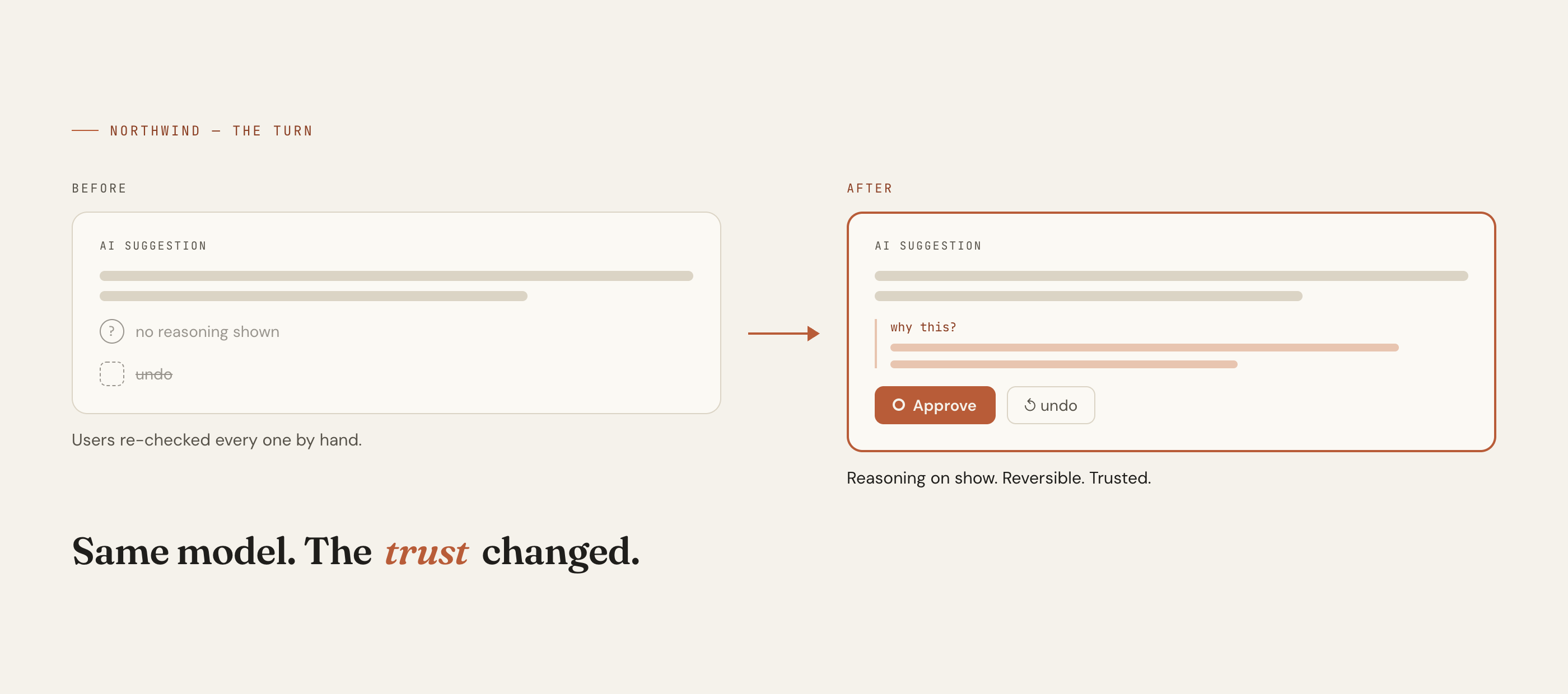
Same model. The trust changed.
We designed the trust, not the model.
The fix map was small and specific — all experience-layer work. No model retraining, no re-platforming.
- Reasoning-on-demand on every suggestion — “why this?” answers inline
- Confirm-before-act on the two consequential actions; everything else runs freely
- A dry-run preview so users see the effect before they commit
- The weakest flow — bulk actions — redesigned and handed to engineering
The model never changed. The trust did. That’s the whole job.
After the fixes: far more people using it, fewer confused support tickets — shipped in a single sprint.
What would an audit surface on your product?
Ten days, fixed scope. The gap between what you’d score and what we’d find is usually where the value is.